
Master Peace Lily care! Learn the secret to getting beautiful white blooms, how to fix brown tips, and why this air-purifying indoor plant droops.
Have you ever wished for a houseplant that could clearly “talk” to you when it needs something? A plant that rewards you with elegant, pure white blooms while actively scrubbing the air in your home? If you are nodding yes, then you need to meet the enchanting Peace Lily.https://plantroopan.com/product/peace-lily-spathiphyllum-4-inch-elegance-for-air-purification/
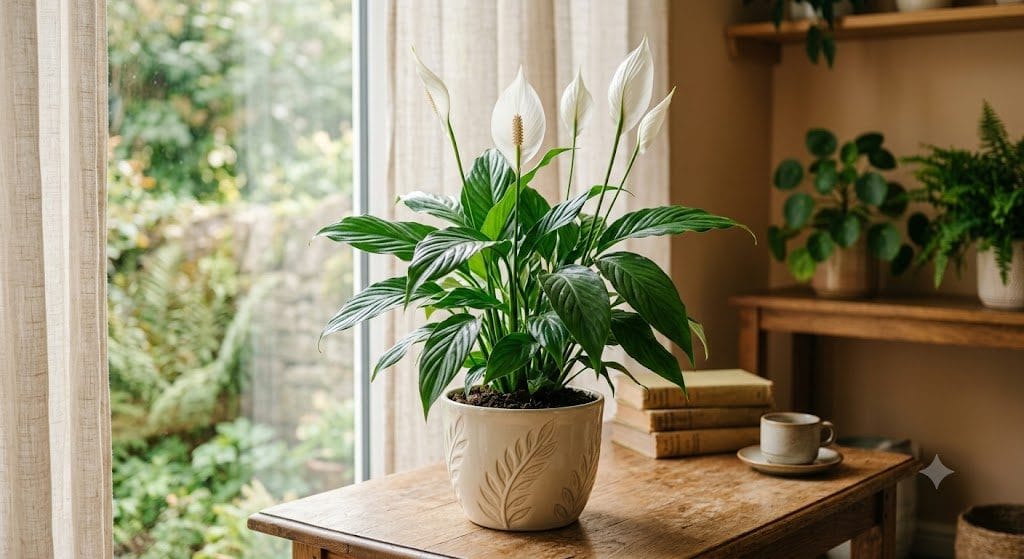
With its glossy, dark green leaves and striking white flowers, the Peace Lily is the epitome of indoor grace. It perfectly balances a wild, tropical feel with refined, minimalist beauty. Best of all, it is famous for being incredibly communicative—it will quite literally dramatically faint to let you know it’s thirsty, only to bounce right back to life after a good drink! Let’s explore exactly how to keep this beautiful, air-purifying powerhouse thriving in your home.
2. Quick Overview
The Peace Lily (Spathiphyllum) is one of the most beloved houseplants across the globe. Despite the name, it isn’t actually a true lily! It is an evergreen tropical perennial celebrated for its gorgeous white “flowers” (which are actually specialized leaves called spathes) and its ability to thrive in lower light conditions where other flowering plants would quickly perish. It is a fantastic choice for both beginners and seasoned plant parents who want a burst of green and a touch of floral elegance indoors.
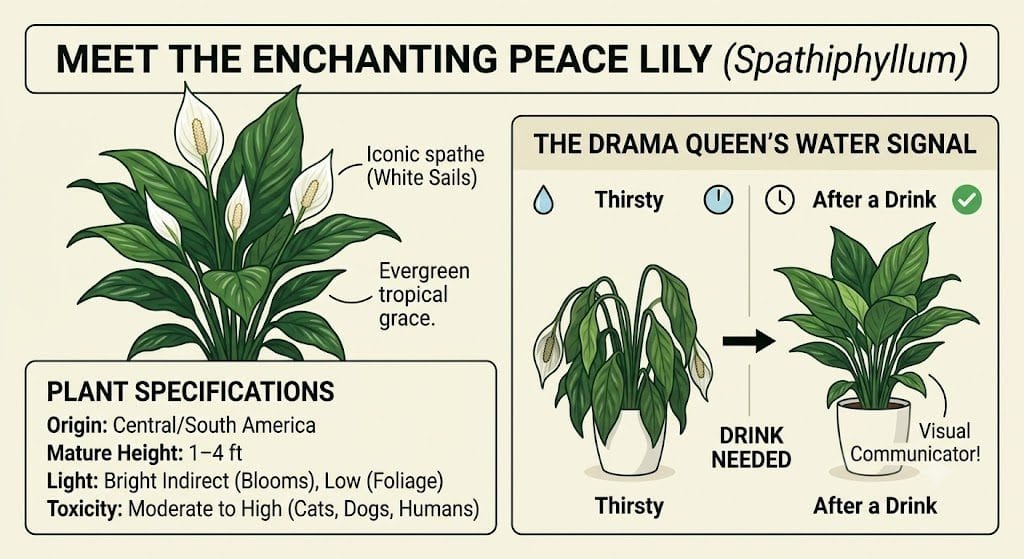
3. Plant Specifications
Here is a quick snapshot of what you need to know about the classic Peace Lily:
| Specification | Details |
| Botanical Name | Spathiphyllum species |
| Common Name | Peace Lily, White Sails, Spathe Flower |
| Family | Araceae (Aroid family) |
| Plant Type | Evergreen tropical perennial |
| Origin | Tropical rainforests of Central and South America |
| Mature Height | 1 to 4 feet indoors (depending on the variety) |
| Mature Width | 1 to 3 feet |
| Growth Rate | Moderate |
| Lifespan | 3 to 5+ years (and easily propagated to live indefinitely) |
| Toxicity | Toxic to cats, dogs, and humans if ingested |
| Difficulty Level | Easy (Highly communicative!) |
4. Plant History
The Peace Lily calls the dense, humid rainforests of Colombia and Venezuela its ancestral home. In the wild, it grows vigorously across the forest floor, thriving in the dappled sunlight that filters through the thick canopy above.
It was first introduced to European botanists in the late 19th century. The common name “Peace Lily” comes from its iconic white blooms, which closely resemble the white flags of surrender, symbolizing peace, tranquility, and rebirth. For decades, it has been a traditional and deeply meaningful gift to offer condolences, celebrate a new home, or simply wish someone well.
5. Why You’ll Love This Plant ❤️
There are so many reasons this plant is a household staple:
- The Drama Queen: It visually droops when thirsty, taking all the guesswork out of watering!
- Low-Light Bloomer: It is one of the very few indoor plants that will reliably produce flowers even without bright, direct sun.
- Air-Purifying Champion: It is a heavy hitter when it comes to filtering out nasty indoor pollutants.
- Lush Aesthetics: The deep, glossy green foliage provides stunning contrast to the crisp white blooms, fitting perfectly into any decor style.
6. Growing Instructions
Setting your Peace Lily up for a long, healthy life starts with understanding its rainforest roots.
- Best climate: Warm, humid, and sheltered.
- Pot selection: A plastic or ceramic pot with excellent drainage is crucial. They do not like their roots to completely dry out, so avoid highly porous terracotta unless you water very frequently.
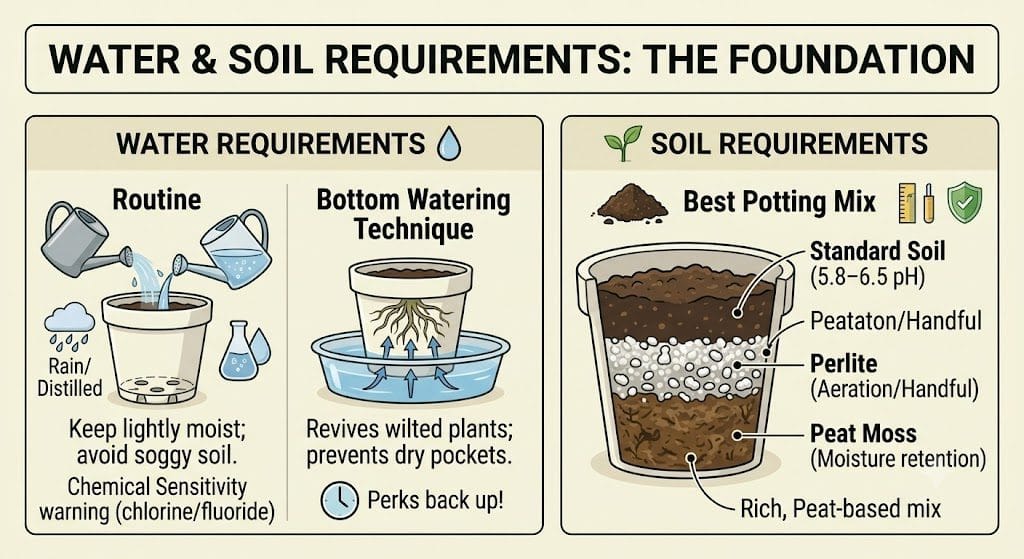
- Soil mix: A rich, peat-based potting mix that holds moisture but drains well.
- Watering: Keep the soil consistently lightly moist, but never soggy.
- Fertilizer: Feed with a balanced, diluted liquid fertilizer every 6 weeks during the spring and summer.
- Temperature: Keep it between 65°F to 85°F (18°C – 29°C).
- Humidity: It loves high humidity but adapts well to average indoor levels.
- Repotting: Repot every 1–2 years, or when you notice it needs watering much more frequently than usual.
- Growth speed: Moderate. You will see fresh leaves regularly during the warmer months.
7. Plant Care Guide
Routine care for a Peace Lily is simple, especially once you learn to “read” its signals.
- Watering schedule: Typically once a week, but let the plant tell you! Wait until the top inch of soil is dry, or the leaves just begin to sag.
- Fertilizer routine: They are sensitive to over-fertilization. Use a weak dose of liquid fertilizer only during the active growing season. If the leaf tips turn brown, cut back on the food!
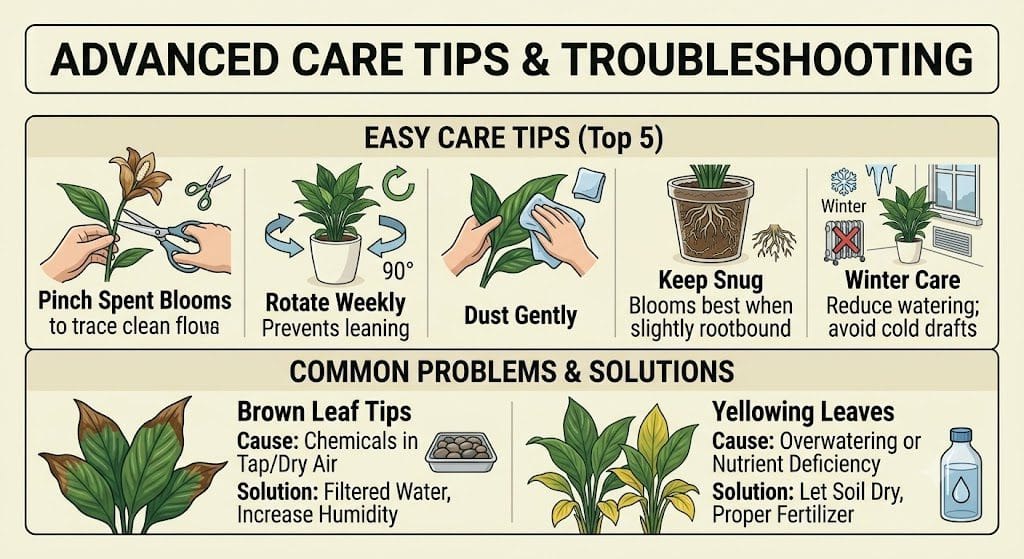
- Cleaning leaves: The wide leaves collect dust quickly. Wipe them down with a damp cloth every few weeks to keep them glossy and able to photosynthesize.
- Pruning: When a white flower eventually turns green or brown and dies, simply trace the stem to the base of the plant and snip it off with clean scissors.
- Pest prevention: Keep the leaves clean to deter spider mites and aphids.
- Seasonal care: In winter, move it away from drafty windows or heating vents. It will drink less water, so adjust your routine accordingly.
8. Sunlight Requirements ☀️
Light is the secret to getting those beautiful white blooms!
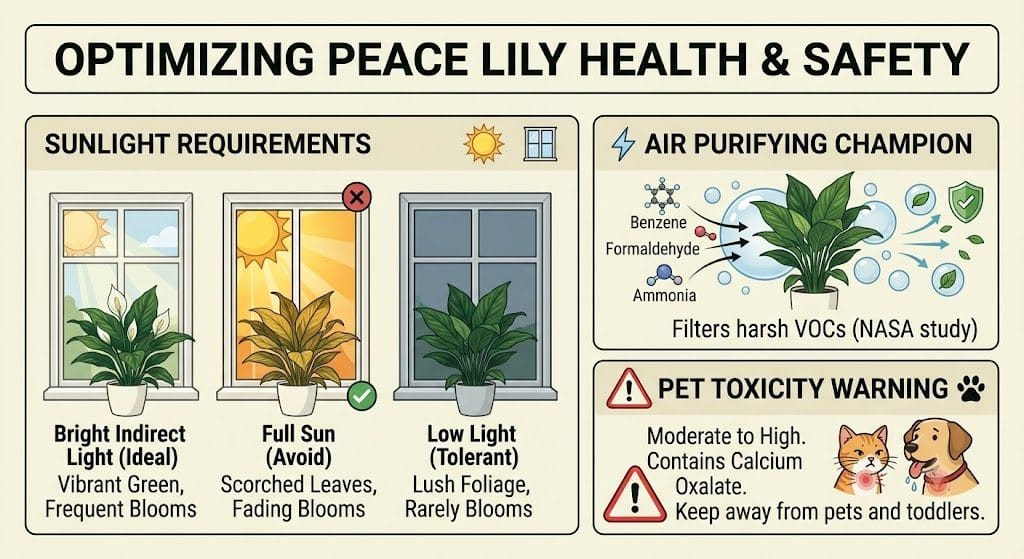
- Bright Indirect Light (Ideal): This is the perfect balance. Near an East-facing or North-facing window, the plant gets enough energy to produce flowers without burning its leaves.
- Full Sun: Avoid entirely! Direct midday sun will severely scorch the leaves and turn them pale yellow or brown.
- Partial Sun: Gentle morning sun is fine, but protect it from harsh afternoon rays.
- Low Light: The Peace Lily will happily survive in a dark corner or an office with only fluorescent lights. It will grow beautifully green foliage, but it likely won’t produce any white flowers in low light.
9. Water Requirements 💧
This plant loves a drink, but it hates wet feet.
- How often to water: Wait until the top 1–2 inches of soil are dry. When it needs water, the leaves will noticeably droop. After a thorough soaking, it will perk back up within hours!
- Signs of overwatering: If the leaves are turning yellow, but the soil is wet and the plant isn’t drooping, you are drowning the roots. This can lead to fatal root rot.
- Signs of underwatering: Dramatic wilting, crispy brown leaf edges, and a plant that completely flops over.
10. Soil Requirements
Because they need a balance of moisture retention and aeration, standard soil isn’t quite enough.
- Soil pH: Mildly acidic, aiming for a pH between 5.8 and 6.5.
- Best potting mix: Mix standard potting soil with a generous handful of perlite and a bit of peat moss or coco coir.
- Drainage needs: The pot must have drainage holes. Water should flow through the soil easily.
11. Temperature & Humidity
Bring the tropical rainforest to your living room!
- Temperature: They are sensitive to the cold. Keep them in rooms that stay above 60°F (15°C) at all times. Keep them far away from uninsulated windows in the winter.
- Humidity: While they survive in standard household humidity, they thrive in high humidity (above 50%). If your leaf tips are constantly turning brown, add a humidifier or place the pot on a tray filled with pebbles and water.
12. Fertilizer Guide
Peace Lilies are actually quite sensitive to heavy chemicals in fertilizers.
- Which fertilizer: A balanced, water-soluble houseplant fertilizer (like 20-20-20).
- Frequency: Every 6 weeks during spring and summer.
- Best season: Stop fertilizing completely in the late fall and winter.
13. Easy Care Tips
Top 10 Tips for Peace Lily Success:
- Filter Your Water: They are very sensitive to chlorine and fluoride in tap water, which causes brown tips. Use filtered, distilled, or rainwater!
- Embrace the Droop: Let the plant slightly droop before watering to ensure you aren’t overwatering.
- Keep it Snug: They bloom best when slightly rootbound. Don’t rush to put them in a massive pot.
- Wipe the Dust: Dusty leaves cannot absorb light properly, leading to fewer flowers.
- Snip the Spent Blooms: Cut old, dying flowers off at the base to redirect the plant’s energy into new growth.
- Avoid Cold Drafts: Keep them away from exterior doors and AC vents.
- Look for Green Blooms: If the white flowers turn green, it’s entirely natural! It just means the bloom is aging.
- Flush the Soil: Once every few months, run water through the pot for a few minutes to flush out built-up fertilizer salts.
- Divide to Multiply: When repotting a massive plant, you can carefully pull the root clump apart to create two or three new plants!
- Don’t Panic if it Doesn’t Bloom: If it’s strictly green, it just needs a slightly brighter spot (indirect light!) to trigger flowering.
14. Common Problems & Solutions
| Problem | Cause | Solution |
| Brown leaf tips | Tap water chemicals (fluoride/chlorine) or very dry air. | Switch to filtered water and increase the humidity around the plant. |
| Yellowing leaves | Usually overwatering or old age. | If it’s a bottom leaf, it’s just old age. If many leaves are yellow, let the soil dry out more. |
| Plant is totally wilted/collapsed | Severe underwatering. | Give the pot a thorough soak in a bucket of room-temperature water for 20 minutes. It will bounce back! |
| No flowers | Not enough light. | Move the plant closer to a bright, indirect light source. |
15. Uses of the Plant
The Peace Lily is incredibly versatile when it comes to interior styling:
- Home decoration: Adds a touch of soft, organic elegance to living rooms and dining tables.
- Office decoration: Thrives under fluorescent lights, making it the ultimate cubicle companion.
- Bathroom luxury: The high humidity of a bathroom with a frosted window creates a perfect environment for massive growth.
- Sympathy/Gifting: A traditional, deeply meaningful gift to symbolize peace, sympathy, and enduring life.
16. Air Purification 🌿
If you want a plant that works a second job as an air filter, this is it!
- Does it improve air quality? Yes, it is one of the absolute best. It was a top performer in the famous NASA Clean Air Study.
- Pollutants reduced: The Peace Lily actively breaks down toxic gases like benzene, formaldehyde, trichloroethylene, xylene, and even ammonia!
17. Pet Friendly? 🐶🐱
Caution is highly advised.
- Safe for Dogs? No.
- Safe for Cats? No.
- Toxicity level: Moderate to High.
- Precautions: The plant contains calcium oxalate crystals. If a pet chews on the leaves or stems, these microscopic crystals cause intense burning, swelling, and drooling in the mouth and throat. Keep it well out of reach of curious pets and toddlers. (Note: True lilies are highly lethal to cats; the Peace Lily is not a true lily and is less dangerous, but it will still cause severe discomfort and requires a vet visit).
18. Best Places to Keep This Plant in Your Home 🏡
- Bedroom: Excellent for purifying the air while you sleep, and its dark green aesthetic is incredibly calming.
- Bathroom: The steam from your showers provides the perfect humid environment.
- Office Desk: It happily handles artificial lighting and adds a soft, welcoming touch to a stressful workspace.
- Living Room: Place it on a side table near an East-facing window to enjoy constant, beautiful blooms.
19. Tropical Vibes 🌴
The Peace Lily brings a very specific type of tropical vibe—it is less “wild jungle” and more “luxury resort.” The broad, ribbed, dark green leaves look incredibly polished, while the stark white spathes add a clean, architectural element. It bridges the gap between lush tropical foliage and minimalist modern design, making any space feel instantly more serene, sophisticated, and intentionally styled.
20. Fun Facts
- The white “petal” isn’t a flower! It is a modified leaf (a bract) called a spathe. The actual flowers are the tiny, bumpy structures on the yellow spike (the spadix) in the center!
- In Feng Shui, the Peace Lily is considered highly auspicious, believed to harmonize the energy in a room and bring calm.
- Because they filter ammonia from the air, they are fantastic plants to keep near a cat’s litter box!
- The scientific name Spathiphyllum translates from Greek meaning “spathe leaf.”
- As the spathe ages, it will naturally turn green. It isn’t sick; it is just photosynthesizing!
- They are technically epiphytic in some wild environments, meaning they can grow on decaying logs or in the crotches of trees.
- Unlike most plants, they are highly communicative. Their dramatic wilting is a harmless defense mechanism that prevents massive water loss.
- If you notice a fine white powder on the leaves below the flower, that is just natural pollen dropping from the spadix!
21. Benefits
- Communicative: Takes the guesswork out of watering by drooping when thirsty.
- Air Purifying: Filters out a massive range of harsh household chemicals.
- Low-Light Tolerant: Adds vibrant green life to dark rooms.
- Beautiful Blooms: One of the easiest indoor plants to coax into flowering.
- Mental Wellbeing: The presence of bright green foliage and white flowers significantly reduces stress and anxiety.
22. Is This Plant Good for Beginners?
Absolutely. The Peace Lily is the ultimate “training wheels” plant for beginners. The biggest mistake new plant owners make is overwatering, but the Peace Lily solves this by literally telling you when it needs a drink. Wait for the slight droop, give it a good soak, and watch it spring back to life. It is deeply forgiving, beautiful, and highly rewarding to grow.
23. Frequently Asked Questions (FAQs)
1. Why are the tips of my Peace Lily turning brown? Brown tips are almost always caused by the chemicals (fluoride and chlorine) in tap water, or incredibly dry air. Switch to filtered or rainwater!
2. Why is my Peace Lily not flowering? While it survives in low light, it needs bright, indirect light to produce enough energy to bloom. Move it closer to a window.
3. Why did my white Peace Lily flower turn green? This is a completely natural part of the flower’s life cycle. As it ages, it produces chlorophyll and turns green. You can simply cut it off at the base.
4. How do I revive a totally wilted Peace Lily? Don’t panic! If the soil is bone dry, submerge the bottom of the pot in a bowl of water for 30 minutes, then water it from the top. It should perk up in a few hours.
5. Is the Peace Lily toxic to cats? Yes. It contains calcium oxalate crystals which cause severe mouth pain and swelling if chewed. Keep it away from all pets.
6. Should I mist my Peace Lily? Misting only provides a very brief humidity boost. If you want to increase humidity effectively, use a humidifier or a pebble tray beneath the pot.
7. Why are the leaves on my Peace Lily turning yellow? Yellow leaves usually indicate overwatering (if the soil is soggy) or a nutrient deficiency. Ensure the pot has drainage holes.
8. Do I need to cut off the dead flowers? Yes. Once a flower turns brown or entirely green, snip the stem off at the base to redirect the plant’s energy to new growth.
9. Can I put my Peace Lily outside? Only if you live in a very warm, humid climate (USDA Zones 11-12) and keep it in full shade. Direct sun will scorch it quickly.
10. How often should I fertilize my Peace Lily? Feed it lightly every 6 weeks during the spring and summer. Do not fertilize it during the winter.
24. Final Verdict
The Peace Lily is an absolute triumph of a houseplant. It offers the rare combination of lush foliage, stunning flowers, and unmatched air-purifying abilities, all wrapped in a plant that practically tells you how to care for it. While pet owners need to be mindful of placement, anyone looking for an elegant, low-light tolerant, and highly rewarding plant should make the Peace Lily their very next purchase.